Haunting the Domestic: Mark Bankin’s Scarecrow
Alishanee Chafe-Hearmon
May 11th 2026
Berlin
In a small blackbox theater on West 36th street, an ensemble of dancers performed Scarecrow, a dance theater piece choreographed and conceptualized by Mark Bankin.
The piece, which appeared both familiar like grandma’s house, and terrifying like a nightmare, took place on a plane where time and space folded into itself. The clock no longer made sense. Linearity was absent, and instead a dominant looping took effect. This created a sense of disorientation, dissonance, and confusion. Monologues and verses by stone tsao offered anguished imagery interspersed with explosive movement sequences. Each woman was like a mirror of the other, the same flesh but slightly distorted, different forms forcing limbs into shape and exerting a strong will upon the dancer’s bodies.

Throughout the piece a modest hyperfeminine posture was taken, alongside positions of fear, statues of dread, and expressions of suffering that followed sequences of impeccable movement. The dance hits the performers like an attack from a supreme and external force, a trace of regret lingers, and a hint of putrid decay lurks in the corner. Something other than the audience seems to be watching the dancers.
Mark’s choreography was complex and executed with a precision achieved only by an absolute dedication and meticulousness from the director and cast.
Surprising directional shifts, unique locomotion and hysteric persistence were skillfully woven through spoken verse, gestures and tableaux. A paradox; controlled movement choreographed to look out-of-control, juxtaposed by vignettes of self harm, housework, marriage and chores. Using mundanity alongside the uncanny, the ordinary and the extraordinary, Mark illustrated an increased contrast by
comparison. Possessed dancers, haunted by their long hair trailing in the wakes of their
movement, forcefully exercised their demons.
On stage, a large wardrobe was used by the dancers to enter and exit, the set piece became a portal to enter and exit different mental states. They seemed haunted by a past, a memory, or a radio frequency. The set and sound design contributed to the eeriness; flickering lightbulbs, endlessly ringing telephones, antique furniture,
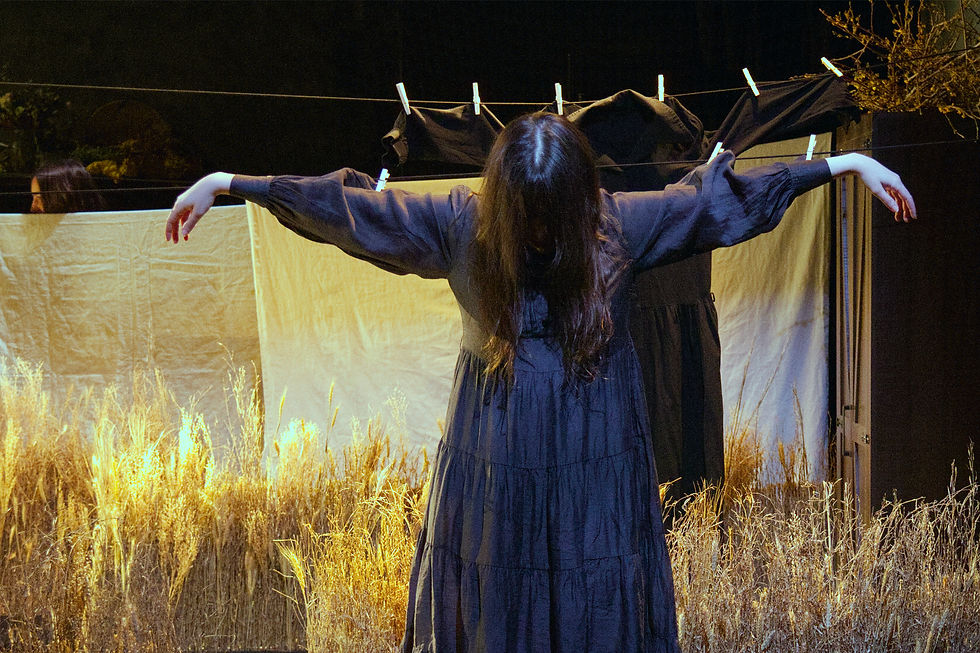
decaying flowers, a wheat field ready to be harvested, the ashes of a loved one in an urn. The piece projected an image of a pitiful feminine ghost, she was both weak and powerful; wilting while fighting for her life. She hysterically applied lipstick, hung laundry and sewed hems. As performers contorted their faces into inhuman expressions and tears ran down their faces the dance became grotesque. But not in a violent way, rather through a slower simmer of body horror and otherworldly warfare. Mark made this ghost the active vessel for the macabre and the mystical.
The dancers were crucified on stage by the choreography, the image of the cross superimposed onto the scarecrow motif. I had the feeling that lingers around the hallways of insane asylums and hospitals, intense simultaneous sorrow and horror. After Mark Bankin’s piece Scarecrow ended, the applause excitedly began, and I was brought back to reality. Yet the spirit that Mark conjured still haunted the space. The piece felt necessary, something had been communicated through the performance that could not have been communicated with language.
Photos: Jessica Hsu


Comments